AI Benefits & Risks — The Honest Conversation Every IT Professional Needs To Have
AI is not coming. It is already here. The real question is — are you using it, or are you watching others use it?

AI is not coming. It is already here — sitting inside the tools you use every day. The real question is not whether AI will affect your career. It is whether you are going to use it as an advantage or ignore it until it becomes a
problem.
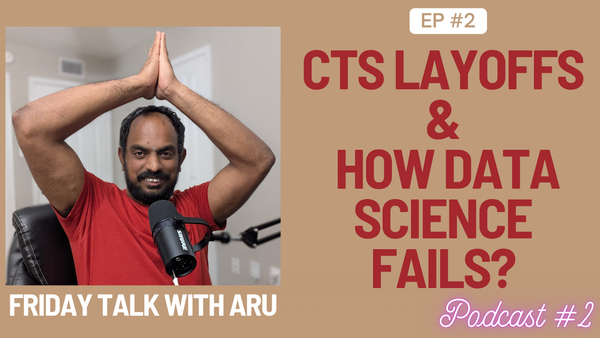
In this week's Friday Talk with Aru, I had an honest conversation about exactly this — no hype, no fear-mongering, just a real look at what AI means for those
of us already working in IT.
AI Is Already In Your Workplace
When you open GitHub Copilot and it completes your code — that is AI.
When you ask ChatGPT to explain a bug you have been staring at for two hours — that is AI.
When your data pipeline flags an anomaly automatically — that is AI.
Most IT professionals are already touching AI tools daily without fully realising it. The difference is between using it consciously and getting the most out of it — versus using it passively and missing the real advantage.
What AI Actually Does For IT Professionals
This is where it gets practical. AI is not one generic thing — it shows up differently depending on your role.
Developers — Tools like GitHub Copilot and Cursor can write boilerplate code, suggest fixes, review your work, and generate test cases. Work that used to take
half a day now takes an hour.
Data Engineers & Analysts — AI helps write complex SQL queries, explain datasets, spot data quality issues, and generate pipeline code. Tools inside Databricks and platforms like DataGPT are already doing this.
QA & Testers — AI can auto-generate test cases, find edge cases you would normally miss, and speed up regression testing significantly.
DevOps & Cloud Engineers — AI tools help writeInfrastructure as Code, monitor systems, detect incidents faster, and suggest cloud cost optimisations.
The pattern is the same across every role. AI handles the repetitive and time-consuming parts so you can focus on thinking, decision-making, and the work that
actually needs a human.
The Gap That Is Opening Up Right Now
Here is the part I feel most strongly about.
Two developers. Same experience. Same company. Same starting point.
One starts using AI tools daily — learns to prompt well, integrates AI into their workflow, delivers faster, takes on more complex work.
The other ignores it — says "I know how to code, I do not need this."
Six months later — who gets the interesting projects? Who becomes harder to replace?
This is not about AI replacing you. It is about a person who uses AI replacing a person who does not. That gap is opening up right now, and it is going to widen fast.
The good news — you can choose which side you are on.
How To Actually Start (Without Overwhelming Yourself)
You do not need to become a Machine Learning engineer. You do not need to understand how neural networks work.
What you need is simple — learn to use AI tools that are relevant to your current role.
Start with ChatGPT or Claude for daily work questions. If you are a developer, try GitHub Copilot for one week. If you work with data, explore the AI features inside
your existing tools. Then go one level deeper and learn what Prompt Engineering is — it is basically how to talk to AI properly to get useful results.
Thirty minutes a day. Two to three months. That is all it takes to go from AI-curious to AI-confident.
Now The Other Side — The Real Risks
Let us be honest here. AI is genuinely going to transform and in some cases replace certain types of work. Not all roles. Not overnight. But certain profiles
are at real risk if they do not adapt.
Junior developers who only write simple CRUD applications or copy-paste code will find AI can do that faster and cheaper. The bar for what a junior developer
needs to offer is going up.
Manual testers who only do repetitive QA work without understanding automation or AI-assisted testing are in a vulnerable position.
Basic data reporting — if your job is pulling the same report every week, natural language querying tools are already letting business users do that themselves.
Tier 1 IT support — simple troubleshooting and FAQ-based support is increasingly being handled by AI chatbots.
The roles are not disappearing overnight. But the nature of work inside these roles is shifting. And people who only do the tasks AI can now do will find themselves
under pressure sooner than they expect.
Three Broader Threats Worth Knowing
Beyond your own role, there are three things worth being aware of as IT professionals.
Over-reliance on AI output. AI makes mistakes. It confidently gives you wrong answers sometimes. If you stop thinking critically and just trust whatever AI
generates — in code, in data, in analysis — you will ship bugs, make bad decisions, and slowly lose the skill to catch them yourself.
Job market compression. When one developer with AI can do the work of three, companies may hire fewer people for certain roles. This is already happening in some markets. The competition for strong roles is going
to get tighter.
Skills becoming outdated faster. The half-life of a specific technical skill is getting shorter. What is cutting-edge today might be automated in two years.
Continuous learning is no longer optional — it is survival.
What You Need To Do Right Now
Three clear actions.
Stop ignoring AI tools. You do not have to love them. But you have to understand them. Ignorance is not a strategy anymore.
Protect your thinking skills. Use AI to go faster — but do not let it replace your ability to reason, problem-solve, and make judgement calls. Those are your
most valuable assets and AI cannot take them unless you give them up.
Build in the direction AI cannot easily go. System design, architecture decisions, stakeholder communication, business context, leadership — these are
deeply human skills. Grow in these directions and you
become more valuable, not less.
Final Thought
AI is not your enemy. But it is also not something you can ignore and hope it goes away.
The people who are going to thrive in the next five years in IT are the ones who treat AI as a tool in their hands — not a threat above their heads.
You already have the advantage. You are in the industry. You understand the domain. You just need to add AI on top of what you already know.
That is the move.
🎬 Watch the full episode on YouTube:
https://youtu.be/b0EmyI-k1g4
🎧 Listen on Spotify:
https://open.spotify.com/episode/3BnRFHZLQBxtpyQWVei6Ba?si=xTpCNDJ_RBmfDwmU5dqN9Q
Connect With Us
📲 WhatsApp Community →
https://chat.whatsapp.com/EVEyPBDLB28EFiPyTgypBU
💼 LinkedIn →
https://www.linkedin.com/company/tamilboomi-technologies/
📸 Instagram →
https://www.instagram.com/tamilboomitechnologies/
📞 WhatsApp → +91 9619663272
🌐 Website → https://www.tamilboomi.com/
📧 Email → arumugam@tamilboomi.com